- Worship Strategies
- Posts
- Out of Fresh Music Ideas? Try Reharmonizing Your Worship Set
Out of Fresh Music Ideas? Try Reharmonizing Your Worship Set
By Worship Strategies

Derek Volkmann
December 18, 2023
One of the biggest hurdles that comes up for worship leaders is keeping the congregation's interest piqued. I know, the Word of God transcends the arrangement of notes, chords, and rhythms, but let's face it—your congregation will feel the staleness of the music as you keep playing the same arrangements over...
...and over...
...and over...
Thankfully, there are ways to freshen up your sound just by rearranging the harmonies within a tune that still fit the melody. With the right know-how, reharmonization takes your worship arranging into interesting territory, all while retaining familiarity for your congregation to appreciate.
Takeaways: You'll get a glimpse into MY music composition through how I transform a Christmas favorite into something unconventional but (hopefully) special.
These next sections dive heavy into theory, but don't be afraid—we'll stay VERY GENERAL as possible. Let's dive in!
Case Study: "What Child Is This?"

I was tasked with arranging "What Child Is This?" for my church's Christmas Eve service, and I knew I didn't want to regurgitate a stock arrangement—it can be REALLY boring to play!
So I decided to shake things up by adding some jazz elements to it, but NOT IN AN OBVIOUS WAY.
Here, you can see the original chord progression and melody.
Things stay fairly diatonic to the key of E minor throughout the piece. (The chromatic D-sharp during measures of B7 are considered diatonic to E harmonic minor, so it works out.)
Still, there's nothing really special about this; it's the same familiar structure we've heard year after year.

Now, here's the reharmonized version. It's still in the key of E minor, but I've swapped out the movement in the first measures in favor of a pedal point, where the bass note stays static while other chords moved over it.
To make things even more interesting, in meas. 5, I use a C#m7flat5/E; the effect is something akin to themes from spy films, or songs like "Kashmere" by Led Zeppelin and "Pull Me Under" by Dream Theater.
This sets us up for a chromatic line cliche, moving in half-steps to C7 and then B7, where we highlight blues-y sounds that take us back to early jazz (think the ending of "St. James Infirmary"). I then apply a similar approach to the second half of the form
The overall result is something that is, again, familiar because of the unchanged, original melody, and interesting because of the pedal point and chromatic movement of the chords.
Still, I wasn't done—the song needed something MORE.
Specifically, the song needed an instrumental interlude to bridge between repeated verses and the final chorus of the song.
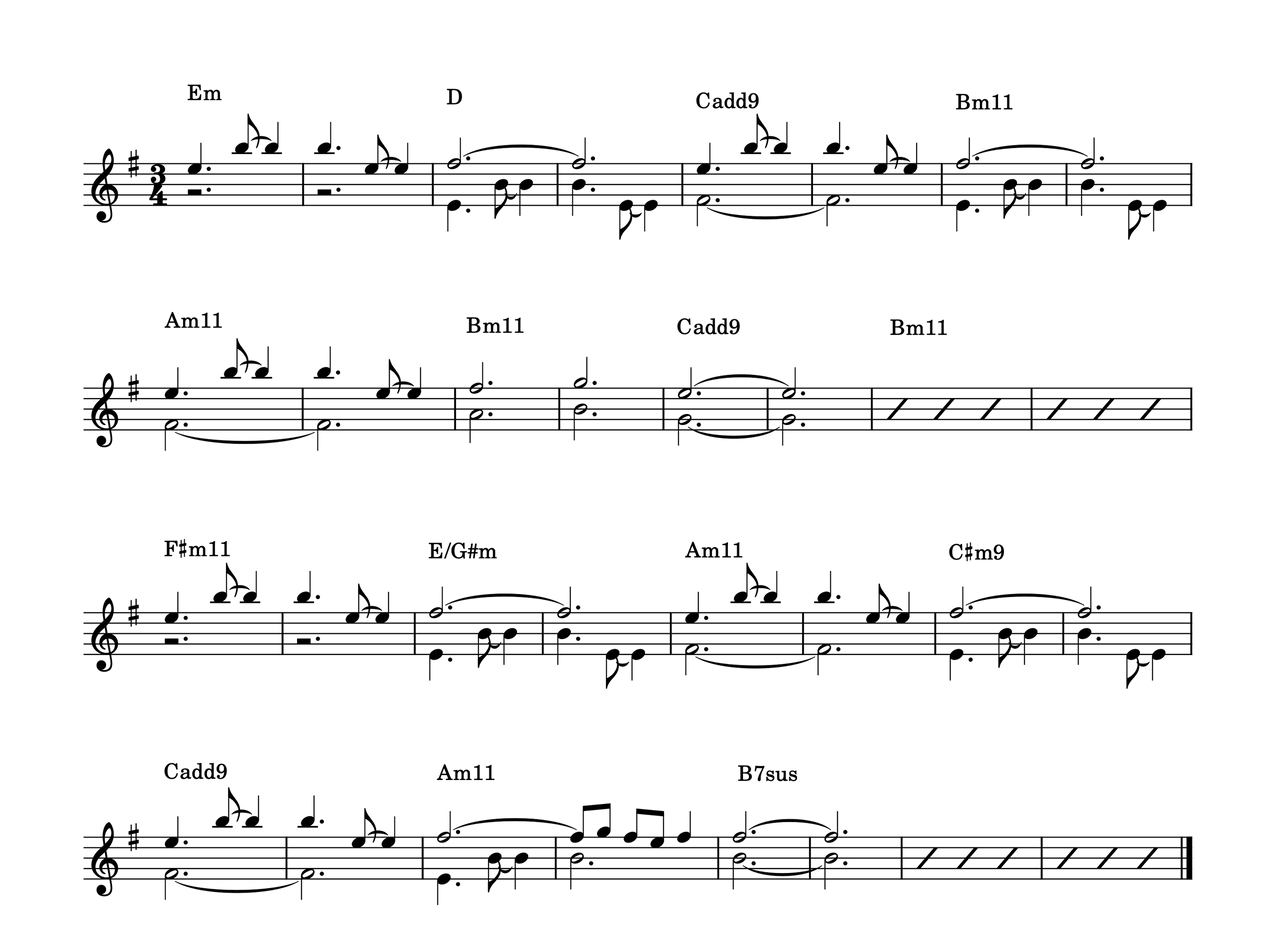
But, I couldn't restate the initial progression, so I opted to explore how to mix the prevailing minor key with parallel interchange (two keys that share the same root, but have different qualities), where I float between chords found in E minor and chords found in E major.
First, I needed to start off with E minor as a way to pivot into E major, so I wrote a new melody comprised of three notes that come from both the E minor and E major scales: E, F#, and B.
The first two systems keep the listener in familiar, E-minor territory, but the change takes place in the third system when we go to F#m11. Usually, an F# chord in the key of E minor is diminished in its quality (1-flat3-flat5), not minor (1-flat3-5). But in this case, we've highlighted enough common tones to transition into more chords that riff on this interchange, going to E/G#m (from E major) to Am11 (back to E minor), C#m9 (E major), and then ending with C to Am and B7, all from E minor.
Those are a lot of chord changes, but the thread that ties them together is that repeated melody of E–B–B–E–F#. (I REALLY dig how it moves from Am11 to C#m9; it echoes Pat Metheny, Herbie Hancock, Snarky Puppy, and a host of other jazz/fusion artists.) Throw in a secondary melody, delayed two measures and pitched one octave down, and you have a shimmering, moving section that takes listeners, singers, and players on a journey together.
The end result: an arrangement that weaves the familiar with the novel, drawing people in with words they know and harmonies that pique their interest. If you want ot play through the entire thing, download it right here—it's totally free!
"What Child Is This?" Reharmonized - Lead Sheet w/ Chord Grids
Final Thoughts
Now, your arrangements don't have to be like mine, where the chromatic alterations and interchanges occur frequently. Sometimes, just a re-arranging of diatonic chords is all you need, see Keith & Kristyn Getty's setting of "Be Thou My Vision" for a fresh take on a classic hymn, right here.
Here's the point: You have creativity and imagination at your disposal, and depending on your situation, a team of like-minded people to pitch in for preparing worship sets. Experiment and explore with how you can tweak and adjust existing songs; it could be composing new interludes and bridges, or completely re-doing verses and choruses. Just be open to new ideas, tempering them with tastefulness.
Be blessed 👊✌️
Derek is the founder and director of Worship Strategies and is also Creative Ministries Director Faith Family Church in Fayette, MO. Outside of ministry, he is active as a musician and entrepreneur. He is married to his wife Kaitlynn, and they have two beautiful daughters.
Want Our Help with Your Worship Ministry?
A big part of what we do at WORSHIP STRATEGIES is to help churches improve how they worship.
Practically, this looks like discipleship, leadership coaching, music instruction, and production advising to help your team grow and excel in their giftings to glorify God and edify His people.
The cool thing? We do this free of financial obligation for each church. We have a growing team of folks who support us in our work for YOU 🫵 and be a blessing to churches who need help but lack tangible resources for improvement.
If you’re interested in working with us, then just click the button below to get started.