- Worship Strategies
- Posts
- Unity, Liberty & Charity: Worshipping Together in a Blended Church (Part 3)
Unity, Liberty & Charity: Worshipping Together in a Blended Church (Part 3)
By Worship Strategies

Derek Volkmann
January 03, 2026
In partnership with

Over the past couple weeks, we’ve talked about unity and liberty within the fabric of belief and practice held by members of nondenominational churches.
Today, we’ll discuss what it means to charitable in all things, even when friction inevitably occurs—and how you can lead a worship team (or your family, or another ministry area) well.
But first, take a look at one of our favorite sources for news—but from a Christian perspective.
Your home for politically-neutral, Christ-first news
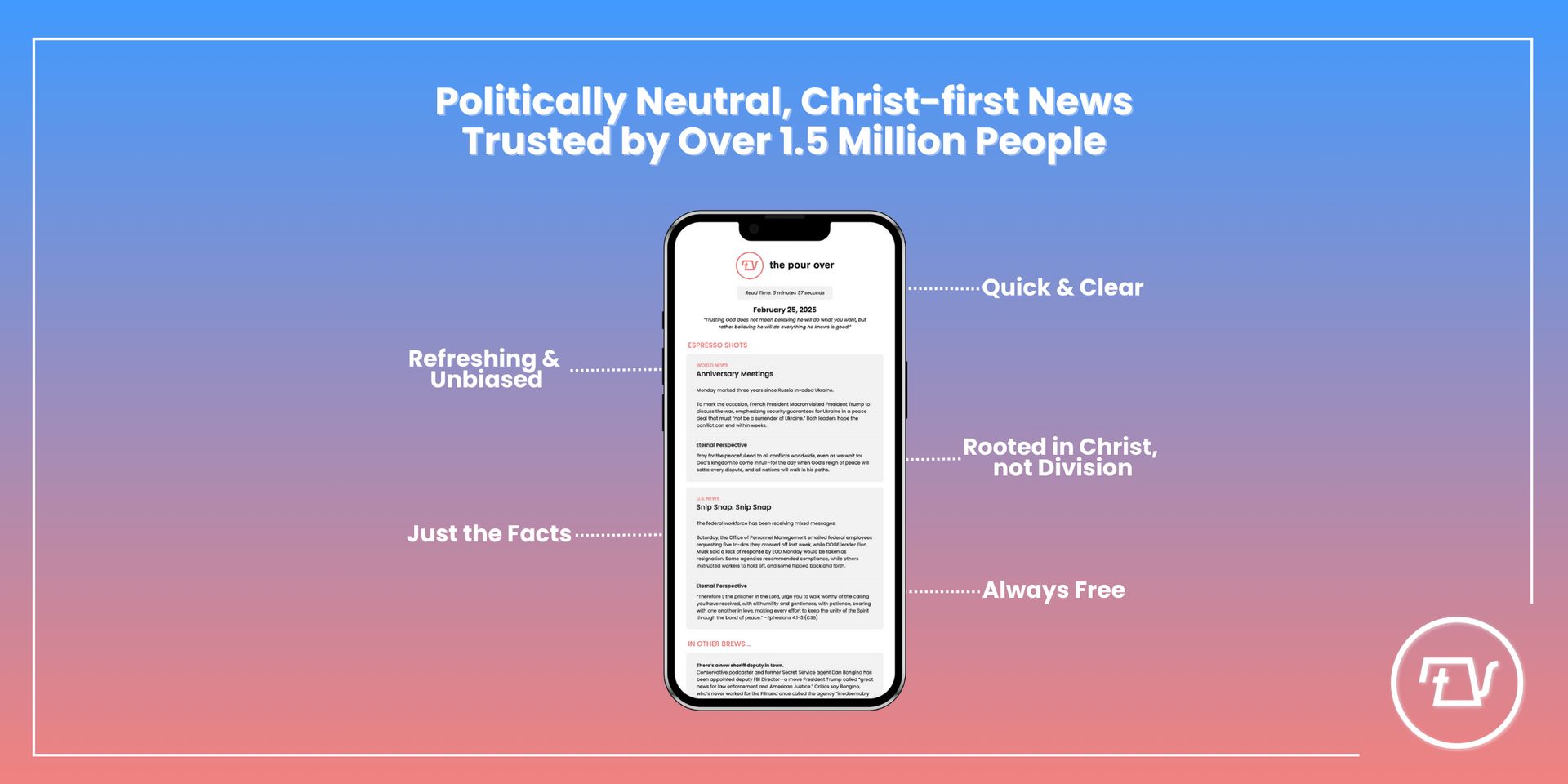
Tired of feeling like you have to pick a side just to stay informed? The Pour Over makes it easy to engage with the news––without the bias, outrage, or anxiety.
Every Monday, Wednesday, and Friday, they deliver quick, entertaining news summaries paired with short biblical reminders to keep you rooted in Christ, not the chaos. Instead of fueling division, the news becomes a tool to strengthen your faith and spark loving action in response.
Over 1.5 million Christians are already reading and staying informed with Christ-first, anger-free, and even kinda funny news.
Join today. It’s always free and totally unsubscribable.
A Brief Recap
To summarize the last two posts, we looked at:
Unity in the Essentials: These are core tenets of the Christian faith. Specifically in a Protestant framework, it is a common confession of who God is as referenced in the Apostles’ and Nicene Creeds, along with affirmation of the Five Solas of the Reformation.
Liberty in the Differences: These are secondary issues, including but not limited to administration and substance of sacraments, spiritual gifts, eschatology, principles of worship, and means of salvation.
Now, we come to charity in all things. This is part of a historical position introduced in the early period of the Reformation by Lutheran theologian Rupertus Meldenius, during the Thirty Years’ War. This conflict is considered one of the most destructive conflicts in human history, beginning initially on the Protestant vs. Roman Catholic divide within the Holy Roman Empire and resulting in an estimated range of 4.5–8 million military and civilian deaths, effected either from battle, famine, or disease.
Meldenius coined this concept during a time in which literal battles were fought on the basis of theological belief, which informed regional agency for the various people groups affected. In other words, since theological persuasion dictated “your tribe,” it also governed your life and liberty. And if your views lay outside of that of the governed region, your ability to “do life” was severely hampered—even subject to capital punishment.
Nowadays, we have moved beyond diversity of belief to be grounds for capital offense or isolation from society, but the spirit of animosity runs through our words and actions nonetheless—but this can be greatly mitigated with a measured approach.
Living Charitably
“Charity” in this sense is a way of speaking and acting based in love, humility, and finding mutual acceptance despite the differences held between groups of Christians. In the modern church, it’s easy for information/internet age dialogue norms (the “keyboard warrior” approach) to shape how we speak and act with our brothers and sisters in Christ, for better or worse.
Like I said in the last post, taking the wrong approach in your communication and action makes you apt to stoke smolders of dissension instead of fanning the flames of unity and building up one another in love.
Here’s the thing: You can’t solve the problem of friction created by differences by avoiding conflict or disagreements. You need to engage each other thoughtfully, which goes beyond mere politeness.
“Thoughtfulness,” in my view, encapsulates a rigorous investigation into:
The “what” of you believe (and theirs).
The “why” behind it.
The “when” and “how” to advocate for particular views, and address or correct misunderstandings.
The “where” of areas that call for submission to higher authority in the church.
The lack of thoughtfulness is where disagreements are amplified, allowing resentment to fester until a fallout occurs. When the disagreement occurs, it’s best to use the thoughtfulness approach in practice by a few key areas:
Don’t use argumentative fallacies. These are logical fallacies in an argument that unfaithfully meet the intellectual and charitable courtesy afforded to “the other guy.” The most common one I’ve seen and experienced from passing conversations, messages from the pulpit, and various media outlets have been straw man arguments (where the “other” sides’ views are misrepresented, oversimplified, or grossly exaggerated to conveniently tear down as easily as one would rip down a “straw man”). Another would be ad hominem attacks, where the character of the person, not the content of their argument, is used against them in the discussion as an attempt to discredit them.
Do use affirmation of shared beliefs in dialogue. In highlighting shared essentials, or shared points within a larger disagreement, you can often come to a shared consensus on how to move forward.
Don’t be ambiguous—do be clear. For some churches, you might be intentionally general in your statement of belief and practice. This is done with good intentions, but there comes a point where you DO want to divide from the get-go, minimizing or eliminating the possibility of severe fracturing later on. This means you’ll likely need to create a written agreement on certain secondary issues, or draft a policy on where/how people can serve if they take exception to official church positions.
It’s important to remember that the goal of “unity, liberty, and charity” is NOT to be used as an excuse to reduce the Christian faith down to the essentials and ignore the rest—it are these very issues that, in the process, lead us into a deeper knowledge and practice of pursuing God’s will and glorifying Him.
Rather, you need to lean into those differences, and in practice, examine where your personality is unfairly skewing your preferences at the expense of your brothers’ liberty, undermining the charity you show. Here are some practical ways you can live this out with your team and family:
There’ll no doubt be some friction between folks who lean more “regulative” with others who lean more “normative” in their principles of worship. On one side, there’s hesitation to do anything spontaneous or overtly expressive. On the other side, some folks may feel stifled from fully expressing themselves. The shared experience is that everyone is there to worship—and we all come with expectation of a real encounter with the Living God. As a worship leader who leans more regulative, I’ve had to learn to give space for personal expression outside of the words we sing corporately. This has largely come in the form of encouraging people to “sing their own songs” unto the Lord while the band underscores the moment with an instrumental vamp. In this way, the people who look for ways to move beyond the screen can do so, and the others can contemplate and savor what has just been sung. And I’ll reiterate: Both groups are in an active encounter with the Living God because of His Spirit being active in the proclaiming of His Word and His indwelling within each believer.
When it comes to doctrinal differences, you need to do: 1) Be clear on where your church stands vs. where you stand; and 2) Present your case not as a polemic (an intense dialogue of persuasive arguments) but rather as an objective review meant for clarification. Personally, I find polemics to be largely unnecessary in the goal of edification. (And they plainly just wear me out 🙄) It takes maturity and self-awareness to enter into that kind of discussion without resorting to fallacy or taking things personally, much of which is where the everyday discussion tends to descend. The only time I enter into that kind of thing is when my own position (or really, any position) is being misrepresented and a word of correction is needed to set things straight. A rebuke is only used as a last measure, after there’s a repeated pattern of uncharitable behavior by the other party, or there is such a grossly willful display of sin (mostly pride) or heresy in public that needs to be immediately addressed. Continue to return to the common ground of the gospel as the needle that threads all sides, despite however intense discussions can become, and highlight a shared motivation to work toward a common goal.
Now, these are just a couple of approaches that I’ve shared, mostly because they are either recent lived experiences or they have been the best methods I’ve found through several years of trial and error (and as far as the Holy Spirit has worked in my personal sanctification—in which I am DEFINITELY a work in progress!).
As you lead your family, team, or church, keep these principles in mind, knowing when to give grace, speak truth in love, and mutually strive for the glorification of our Lord.
Be blessed 👊✌️
Derek is the founder and director of Worship Strategies and is also Creative Ministries Director Faith Family Church in Fayette, MO. Outside of ministry, he is active as a musician and entrepreneur. He is married to his wife Kaitlynn, and they have two beautiful daughters.
Want Our Help with Your Worship Ministry?
A big part of what we do at WORSHIP STRATEGIES is to help churches improve how they worship.
Practically, this looks like discipleship, leadership coaching, music instruction, and production advising to help your team grow and excel in their giftings to glorify God and edify His people.
The cool thing? We do this free of financial obligation for each church. We have a growing team of folks who support us in our work for YOU 🫵 and be a blessing to churches who need help but lack tangible resources for improvement.
If you’re interested in working with us, then just click the button below to get started.